
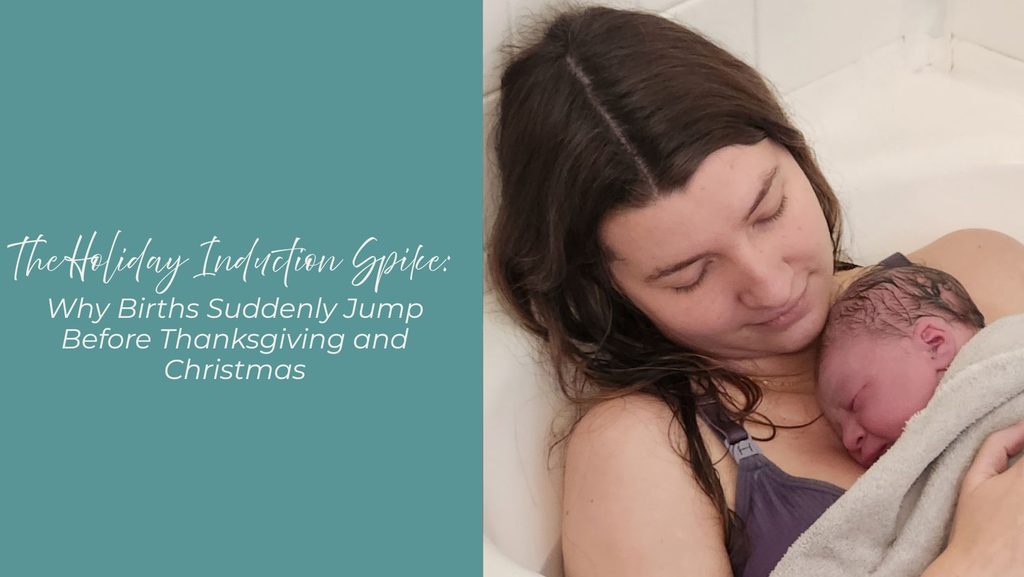
If you look at birth statistics across the United States, a curious pattern pops up every single year.
Babies don’t naturally coordinate their arrivals around bank holidays or long weekends. Yet year after year, birth rates spike sharply in the two or three days right before Thanksgiving, Christmas, and New Year’s Day—followed by an unnatural dip on the actual holidays themselves.
Why? Because of scheduled holiday inductions.
If you are due near the end of November or December, understanding why this seasonal surge happens—and how to tell the difference between a medical recommendation and a scheduling convenience—can help you protect your birth preferences and feel confident in your choices.
Why Inductions Rise Around the Holidays
It isn’t a secret that hospital labor and delivery floors run differently during major holiday weeks. Several practical pressures converge all at once:
- Provider Holiday Schedules: Your OB or midwife may have planned time off, family travel, or rotating holiday call coverage. Many providers genuinely want to be the one delivering your baby—and suggesting an induction before they leave town is often framed as a way to guarantee they are in the room.
- Hospital Staffing and Bed Management: Hospitals frequently scale back elective procedures on major holidays, which creates a bottleneck of scheduled inductions in the days leading up to the holiday break.
- Year-End Insurance Deductibles: On the financial side, families who have already met their annual health insurance deductible often feel pressure to deliver before midnight on December 31st so they don’t get hit with a brand-new deductible on January 1st.
None of these reasons make your provider “bad,” and for some families, picking a predictable date actually brings welcome peace of mind. The problem happens when convenience gets quietly blended with medical necessity, leaving parents feeling like they don’t actually have a choice.
Medical Necessity vs. Scheduling Convenience
There are many valid, evidence-based reasons to induce labor—such as preeclampsia, gestational hypertension, placental concerns, certain cases of gestational diabetes, or going well past 41–42 weeks. When baby or parent needs to be born for safety, an induction is a valuable medical intervention.
However, an elective induction (one scheduled without a medical indication, typically at 39 or 40 weeks) carries a very different set of trade-offs—especially if your body and baby aren’t showing signs of readiness yet.
When labor is induced before your cervix has naturally softened and started to open, the process often takes significantly longer, requires stronger interventions (like Pitocin, continuous fetal monitoring, and IV fluids), and can limit your ability to move freely or rest comfortably during early labor.
How to Advocate for Yourself in the Exam Room
When your provider brings up putting a date on the calendar before Thanksgiving or Christmas, you don’t have to argue—you just need clarity. Asking calm, direct questions puts you back in the driver’s seat:
- “Is there a medical reason for me or my baby to induce before the holiday, or is this optional?”
- “Who is covering on-call deliveries if I wait and go into labor naturally over the holiday weekend?” (Many parents realize they are completely comfortable with another provider in the practice once they ask!)
- “What is my Bishop score right now, and is my body showing signs that an induction would go smoothly?”
- “Can we schedule a non-stress test (NST) and ultrasound check-in instead, and give my body a little more time?”
Remember: an induction offer is not a mandate. If everything looks healthy for both you and your baby, waiting for labor to begin on its own is a completely valid, evidence-based option.
Having Steady Support—No Matter Who Is on Call
One of the biggest reasons parents feel pressured into a pre-holiday induction is fear of the unknown: “What if my doctor is out of town and I end up with a stranger on Christmas Eve?”
That is exactly why continuous doula support makes such a massive difference during the holidays. Hospital shift changes happen, and holiday call schedules rotate—but your doula stays with you from start to finish. Whether your doctor is in town or another provider from the practice catches your baby, you still have a familiar, trusted face by your side who knows your birth preferences, keeps the room calm, and advocates for your comfort every step of the way.
Ready to Feel Confident About Your Birth Options?
Whether you end up scheduling an induction or waiting for baby to pick their own birthday, you deserve unbiased information and steady, judgment-free support.
Contact Stork Helpers today to schedule a free consultation and talk through your upcoming birth!