
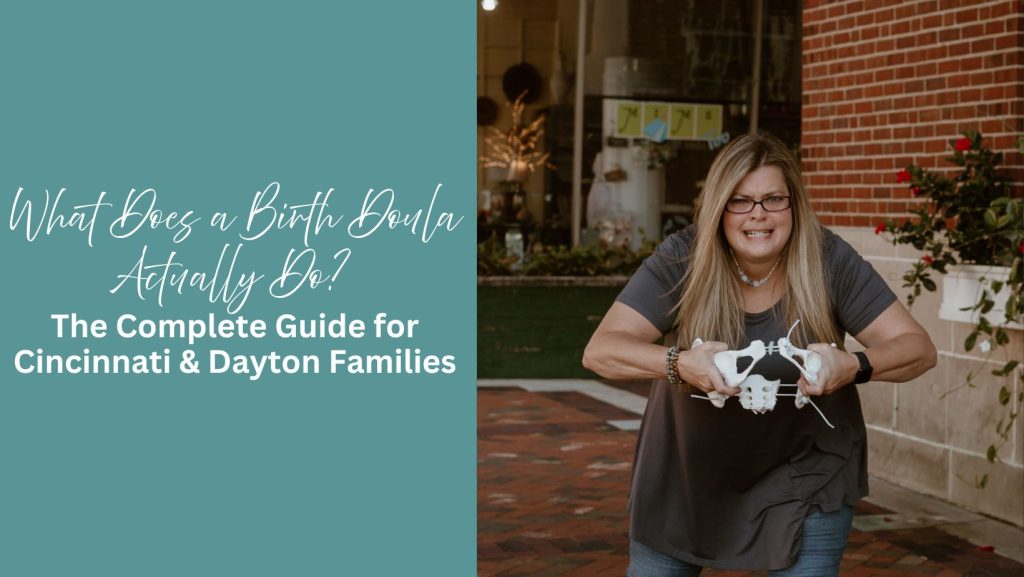
When you find out you’re expecting, your to-do list seems to expand exponentially overnight. Between choosing a pediatrician, designing the nursery, and registering for gear, you’ve almost certainly heard other local parents rave about hiring a birth doula.
However, despite how popular doula care has become across Southwest Ohio, a lot of mystery still surrounds the role. What does a doula actually do when labor starts? How do they work alongside hospital doctors and nurses? And how do they fit into the room without squeezing out your partner?
Whether you are planning a delivery in Cincinnati, Dayton, or anywhere in between, here is your complete guide to understanding the role of a birth doula—and how having one on your team transforms your birth experience.
What Is a Birth Doula? (And What They Are Not)
To understand what a doula does, it helps to understand what they don’t do.
A birth doula is a trained professional who provides continuous physical, emotional, and informational support to expectant parents before, during, and immediately after childbirth.
The biggest distinction to keep in mind is that doulas are non-medical support professionals.
| Feature | Birth Doula | OB/GYN or Certified Nurse Midwife | Labor & Delivery Nurse |
| Primary Focus | Your physical comfort, emotional peace, and advocacy | Medical safety of parent and baby | Clinical monitoring, medication administration, hospital policy |
| Care Timing | Continuous support throughout all of active labor | Intermittent checks; present for delivery | Manages shift changes; cares for 1–2 patients at once |
| Medical Tasks | None (no cervical checks, fetal monitoring, or deliveries) | Performs medical procedures, monitors vitals, delivers baby | Administers IVs/meds, charts vitals, monitors heart rates |
Your medical team is there to ensure a safe delivery; your doula is there to ensure you feel calm, informed, respected, and physically supported through every surge.
What Does a Doula Do Before Labor? (Prenatal Support)
Doula care doesn’t just start when your contractions hit. The foundation of a great birth experience is built during the prenatal months.
During your pregnancy, a birth doula works with you to:
- Build a Personal Birth Plan: A doula helps you translate your preferences into a clear, concise birth plan that local hospital staff can easily read and respect.
- Practice Comfort Techniques & Positioning: You’ll learn hands-on labor shapes, pelvic opening movements, and counter-pressure techniques long before labor begins.
- Filter the Noise: Pregnancy comes with an overwhelming amount of unsolicited advice. Your doula serves as an evidence-based sounding board to answer questions, explain medical terminology, and help you evaluate your birth options objectively.
- Address Birth Anxiety: Unpacking fears around pain, interventions, or past medical trauma allows you to enter your labor space with confidence rather than fear.
What Does a Doula Do During Labor? (In the Thick of It)
This is where the true value of a doula shines. Unlike hospital personnel who shift in and out of your room, your doula is the one constant presence in your birth space from early labor until after your baby is born.
Physical Comfort Measures
Pain management during labor isn’t limited to epidurals. Doulas utilize proven physical techniques to ease discomfort and encourage efficient labor progress:
- Targeted Counter-Pressure: Applying firm pressure to the lower back or sacrum to relieve intense pressure (especially during back labor).
- Double Hip Squeezes: Manually compressing the hips to open the pelvic inlet and ease surge intensity.
- Optimizing Baby’s Position: Guiding you through specific movements—such as side-lying releases, asymmetrical lunges, or using a peanut ball—to help a baby rotate or descent down the birth canal.
- Hydrotherapy & Environmental Control: Utilizing showers, warm tubs, dim lighting, and aromatherapy to maintain a calm, low-stress birthing space.
Emotional & Informational Anchoring
Labor moves in waves, and it can occasionally feel chaotic or overwhelming. A doula keeps the environment grounded by:
- Guiding your breathing when contractions peak to prevent hyperventilation and muscle tension.
- Reassuring you through the intense transition phase when self-doubt usually sets in.
- Explaining procedures, monitor readings, or medical options in plain, easy-to-understand language if complications arise.
How Doulas Support Different Types of Births
There is a common misconception that doulas are only for parents planning a 100% unmedicated home or birth center delivery. This couldn’t be further from the truth. A skilled doula supports your goals, no matter what path your birth takes.
Epidural Deliveries
If you choose an epidural, your doula’s job shifts—it doesn’t end! Once an epidural is placed, you are confined to the bed. Your doula will:
- Frequently reposition your body using a peanut ball to keep your pelvis open and prevent labor from stalling.
- Help manage side effects like shivering, itching, or nausea.
- Ensure you don’t feel “numb to the experience,” keeping you emotionally engaged as delivery approaches.
Unmedicated / Low-Intervention Births
For parents seeking a natural birth, a doula acts as your primary endurance coach. They provide non-stop hands-on relief, keep your mindset positive during intense surges, and help you stay mobile as long as possible.
Gentle C-Sections & Unplanned Surgical Births
If labor leads to an unplanned C-section or you have a scheduled C-section, a doula provides crucial emotional grounding in the operating room. They stay by your head, explain what is happening behind the curtain, help calm anxiety, and assist with immediate skin-to-skin contact in the recovery room.
What About the Partner? (Doulas Don’t Replace—They Empower)
One of the most common worries partners have is: “If we hire a doula, will I be left standing in the corner with nothing to do?”
The short answer is no.
A birth doula is there to support both of you. Partners are often expected to be labor experts, emotional anchors, massage therapists, and medical advocates all at once—while watching someone they love go through immense physical intensity. That’s an impossible burden!
Your doula works shoulder-to-shoulder with your partner:
- Showing, Not Replacing: A doula will show your partner exactly where to put their hands for hip squeezes or where to support your back, making them look and feel like a hero.
- Giving Tag-Team Breaks: Labor can last 12, 24, or 36+ hours. A doula allows your partner to grab a meal, take a quick nap, or use the restroom without leaving you alone in the room.
- Reducing Partner Stress: When your partner feels supported and confident, that calm energy transfers directly to you.
Navigating Southwest Ohio Hospital Spaces
Every labor and delivery unit has its own distinct rhythm, culture, and floor policies. Having a birth team that regularly attends births across Cincinnati and Dayton means you benefit from institutional familiarity.
At Stork Helpers, our doulas regularly support families across the region’s primary birth centers, including:
- Cincinnati Metro: Bethesda North Hospital, Good Samaritan Hospital, UC Health, and Mercy Health systems.
- Dayton & Miami Valley: Miami Valley Hospital, Kettering Health, and Atrium Medical Center.
Because we know how to collaborate respectfully and professionally with local OBs, midwives, and nursing staff, we help foster a spirit of teamwork in your birth room.
What Happens After Baby Arrives? (Postpartum Transition)
A doula’s work doesn’t end the moment your baby is placed on your chest. During the immediate 1 to 2 hours after birth (often called the “Golden Hour”), your doula stays to:
- Support initial skin-to-skin bonding and quiet time.
- Assist with early chestfeeding or first latch guidance.
- Ensure you get a warm meal, water, and time to clean up and rest.
- Document those precious first family photos!
In the weeks following delivery, your doula team follows up with a dedicated postpartum visit to review your birth story, check on your mental health and physical recovery, and ensure your transition into parenthood is smooth.
Frequently Asked Questions About Hiring a Doula
When in my pregnancy should I hire a birth doula?
Most families book their doula during their second trimester (between weeks 18 and 28). Booking early secures your spot on the doula’s calendar and gives you more time to build a relationship during your prenatal visits.
Does insurance cover birth doula services?
While traditional health insurance policies vary, many providers now reimburse for doula care. Additionally, almost all HSA (Health Savings Account) and FSA (Flexible Spending Account) plans cover doula services as an eligible medical expense!
What if my labor goes extremely long?
Professional doula practices operate with built-in backup systems or team models. If your labor extends into a multi-day event, your doula team seamlessly rotates fresh support into your room so you are never left without an energized advocate.
Ready to Build Your Ideal Birth Team?
You don’t have to navigate pregnancy, labor, and the postpartum transition by yourself. At Stork Helpers, we provide compassionate, judgment-free, experienced doula care tailored entirely to your family’s unique goals across Cincinnati, Dayton, and surrounding areas.