
If you are preparing for a baby in the Greater Cincinnati or Dayton area, you have likely received information about the standard childbirth classes offered by your delivering hospital system—whether that is TriHealth, Kettering Health, Christ Hospital, or Premier Health.
Because hospital classes are often inexpensive or even free, it is completely natural to wonder: Is there any real benefit to investing in a private childbirth education class, or do they just cover the exact same material?
Both options have a distinct purpose, but they are built with entirely different goals in mind. Understanding the structural differences can help you choose the right path for your family’s birth goals.
The True Role of a Hospital Birth Class
Hospital-hosted classes are excellent for one specific thing: navigating the logistics of that specific building.
When you take a class through your delivering hospital, you are going to learn exactly where to park at 2:00 AM, which entrance is unlocked after hours, what their standard check-in policy looks like, and what the recovery rooms are equipped with.
However, hospital classes are inherently designed to teach you how to navigate their system. The curriculum is built around their standard protocols, their routine interventions, and how to be a compliant patient within their facility. Because these classes are often large group sessions with tight time constraints, they rarely have the capacity to dive deep into personalized coping strategies or hands-on practice.
The Private Childbirth Education Difference
Private childbirth education—like a dedicated 4 to 6-hour intensive class—shifts the focus from the hospital’s routine to your body’s physiology and your partner’s active role.
Instead of teaching you what the hospital prefers to do, a private class teaches you how labor actually functions and gives you a concrete toolkit to navigate it.
- Unbiased Preparation: A great private class doesn’t have a hidden agenda or a system to protect. Whether your goal is an unmedicated physiological birth, an early epidural, or a scheduled cesarean, private education prepares you for every single scenario with zero judgment. You learn the benefits, risks, and alternatives to common interventions so you can make truly informed decisions.
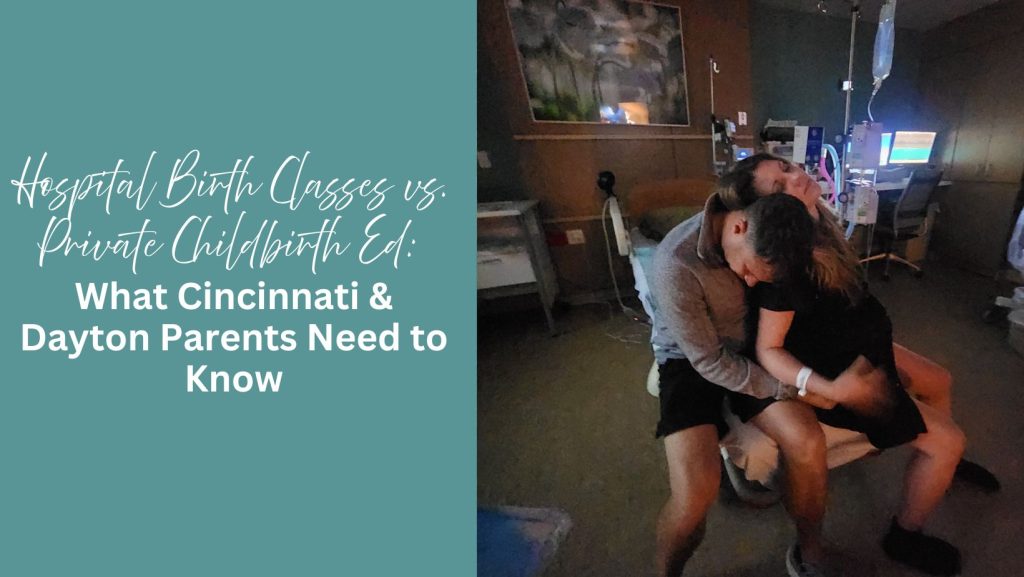
- The “Partner Playbook”: In many standard hospital classes, partners are treated like passive observers who are there to hold a clipboard or watch a slideshow. A private intensive class flips this dynamic, giving your partner an actual physical playbook. They will learn and practice specific hands-on comfort measures, counter-pressure techniques, and positioning strategies so they can be an active, confident anchor in the delivery room.
- Time for Real Practice: Because private classes are structured as focused intensives without the distraction of administrative hospital policy, there is ample time to actually practice breathing rhythms, labor positions, and relaxation techniques until they feel like second nature.
Which Option is Right for You?
If your primary goal is simply to demystify the hospital environment and understand their standard medical timeline, a hospital class will serve you well.
But if you want to enter your birth experience feeling deeply connected to your partner, fully aware of your options, and equipped with a physical toolkit to handle the intense work of labor, investing in private childbirth education bridges that gap.
Many local families actually choose a hybrid approach: they take the quick hospital tour to handle the logistical “where to go” anxieties, and then rely on a private intensive class to build their actual labor confidence.